Thursday, March 31, 2016

On The Hazards of Clement Weather ~


We had a pleasant coastal adventure last week, replete with cameras, wine, and abundant sunshine. My sister came to visit, and along with her two lovely daughters and my wife, the watercolor painter, we rented a condo in Agate Beach, which is near Newport on the Oregon coast. Seemed everyone was in total shock at our great and good fortune, as we happened to have hit that perfect window of opportunity: the first multi-day span of time since, apparently, the Jurassic period wherein the sun was bright, the temperature was warm, and the seas were calm; an early-spring trifecta that the locals would have you believe will never occur again. There was much rejoicing in the land, except, of course, for me. This is not what I came for.

But I am being selfish; it is exactly what my traveling companions hoped for. My little sister, who owns a portrait photography business, lives in the untangled wilderness of suburban Denver, whose denizens not only experience up to 300 sunny days a year, but come to regard it as some sort of birthright. So what do they know. My nieces, young and lovely in an Ipanema-like way, need the sun to survive. A year in Oregon could easily prove fatal. And my wife is a painter; sunshine is Giverny. But sunshine just doesn't do it for me.

Let me make this clear, I'm a downright cheerful guy. I'm only thinking photographically. It seems to me that when the sun shines brightly, I end up taking pretty pictures and maybe not a lot more. And like I said, that's not what I came for. The colors are too easily blown away; the shadows impenetrable. It doesn't even have to be gloomy or foggy (although extra points if it is!) but even a little overcast reveals so much more about the world than we are sometimes prepared to see. These kinds of images are (for me, anyway) more personal, more intuitive, and often reflect inner states that surprise the hell out of me. As I've said here many times, art is autobiography. If I'm going to share my images and thus my stories with you, then let them be candid, a little unsettling, maybe even difficult or hard to fathom, but never, dear God, boring.

The two photos I have posted here, one from that recent coastal trip and the other from about a year ago, are pretty much what I'm talking about. Don't get me wrong, shooting with my sister in the bright, beautiful sun of the Oregon coast was delightful, and I'm glad for that opportunity. But standing beneath the St. Johns Bridge as the fog was rolling in was something altogether different. Call it what you will: contemplative? introspective? moody? somber? Hell, you can call it a taxi if you want. And that's the point. One is the static (albeit lovely) image of the identifiable, the other carries the unremarkable stigma of the nameless. It's downright compelling. That's what I enjoy most about photography.


And that's what I came for.


Wednesday, March 16, 2016

A Little Techno-Talk For A Change ~


I've been attending to my blog for a long time now, and people who follow it tend to ask me the same questions fairly often;  1 -- how (and why) go you go for a particular "look" in the photos you post, and 2 -- what's wrong with you, anyway?  The answer to that first question will be the subject of today's post. As to the second, well, who has that kind of time.

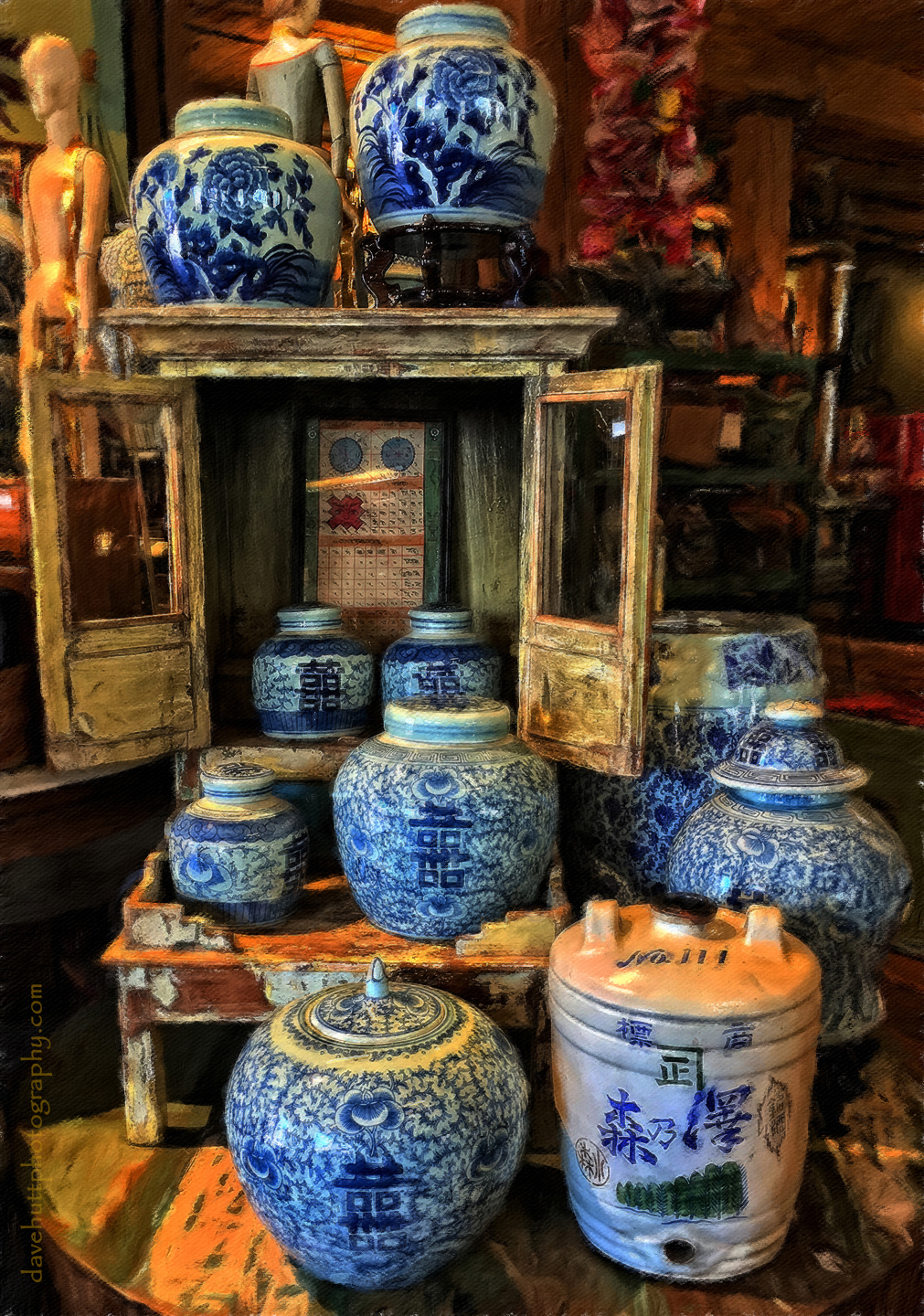
When I shoot with my Canon or mirrorless Fuji, I tend usually to shoot in RAW, and will open that file in Adobe Capture Raw (I'm still using CS6) to resize and maybe tweak with an adjustment or two. My CS6 has the onOne Perfect Suite plug-ins, and that's where I'll go to town and really work that poor bastard. I like being surprised, and there is abundant serendipity in every photo you take. I will, more often than not, drag that file down into a painting program call Arista Impresso Pro, which would actually be a good name for a coffee shop, if you ask me. I use it to create a completely new "painterly" image and then open both it and the original photo as layers in Photoshop, with the painting layer on top, and proceed to erase almost all of it away. I want to be left with just the impression of the painting (as with the photo up above) and maybe some interestingly altered tones and highlights. Depends on my mood, I guess.


If it's a photo made on my iPhone, I'll almost always work it in Snapseed before I import it into Photoshop and proceed onward. The image immediately above is one such example. A different look, a different feeling. I don't think this is anything new with digital photography, either. It may have been chemistry instead of computers, but when I worked with black & white film I spend just as much time and effort in the darkroom making that image come alive for me. And speaking of black & white:


I mean, who said there was anything "realistic" about a black & white photograph, anyway?

There's a ton of b&w controls in onOne, too; the above image was worked with a filter designed to look much the way old Kodak Panatomic-X looked and felt. Heck, it's been so long I'll have to take their word for it, but it brought back all kinds of warm and fuzzy feels, minus the stained fingers. And that's the point. No one ever took a photograph that showed, without pity and without passion, cold reality, because frankly no one knows just what the hell that is. The process that began when the shutter was tripped ends many, many miles away. There is absolutely nothing in the world that fascinates me more than that journey.

Hey, maybe that's what wrong with me.


Thursday, March 10, 2016

Artists and the Rest of Us ~


It's been a great couple weeks to go wandering; predictably unpredictable rainy Oregon weather, some alarmingly early signs of spring, and the company of fine fellows. The inspiration to get out comes often, knocking on my very wet door.  And then there appeared in my Feed of Interesting Articles no less than three (hopefully) inspiring posts wherein two contemporary photographers were heralded as "artists", and the third where the writer, himself a photographer, described in a few brief, perky paragraphs how you, too, could be an artist. Who, me? Obviously it got me to thinking.

First of all.... really? As someone who was quite literally raised in the arts, I reflected upon a few of my life's odd realities, one of which was that, in all those years, and all those skilled painters, sculptors, and printers, I couldn't recall a one of them ever actually referring to themselves as an "artist".  My own dad, an accomplished watercolorist, used that word to describe everyone else in his gallery, but never himself. And I think I know why.

Painting may not be as technical a craft as photography, but craft it is nonetheless, with its own burdens of theory, technology, and innovation. Its finest practitioners work and study their asses off. The goal was always and forever a mastery of their craft to the point where we mere mortals could rightly see their work as the art it truly is. It's no different for photographers. The great practitioners in our field, many of them so inspirational and instructive to this dumb kid, worked with the same fervor and motivation; they experimented, innovated, and created a body of work that we could all look upon legitimately as art. But they are photographs, and the giants who made them were photographers. I'm damn proud of that heritage, and try to live up to it.


Bottom line, it's probably not the labels that count, anyway. Call yourself whatever you like, I'm not qualified to judge anyone's self-expression. The world is tough enough on us as it is. All I know is that I love galleries and museums; I adore looking at paintings and photographs modern and old, and am happy to share my own to an unsuspecting public. But then too, I also love reading novels and poetry. And listening to music (my tastes are eclectic but run a little to jazz). And I tend to think of all their creators as artists, even if they don't themselves.

The gifted Garrison Keillor ends his "Writer's Almanac" with a little benediction that I believe is the best and maybe only advice for all of us who call ourselves painters, photographers, poets -- or artists: Be well, do good work, and keep in touch.

It's all that matters.


Thursday, February 18, 2016

Thanks For The Memories ~


Someday, if I really get to feeling motivated, I'd like to write a book on being a photographer, and title it something like "Perils, Pitfalls, and Paranoia". We need as much to worry about as we can. And what brings me to this melancholic state? Simply, the arrival in my in-box of yet another in that endless stream of articles reminding me that my future, my legacy, my very birthright -- all of it -- is doomed to meaningless and un-readable twaddle in the (probably) not too distant future. Unless I make a lot of prints between then and now.

Well, um, thanks for the heads-up.

So, am I the only one who doesn't fully buy in to the panic? I mean, sure, given a source of light and a splash of silver nitrate and a negative is theoretically printable until hell freezes over. But truth be told, I have lost or damaged my share of negatives in the past, too, and that makes them as un-recoverable as the data on a floppy disk. Oh, and no back-up; the vast majority of my negatives remain scandalously un-printed, apart from their contact sheets.


I do confess to a petit goût of paranoia, though: my photos, since I began shooting exclusively digital, are backed-up on external harddrives, where also reside all the photos formerly living on my 100-year DVDs. I tend not to lose a lot of sleep over it. But data-redundancy is not really the point, as far as I can tell; my concerns are more immediate.The advent of the interwebs, and social media in particular, has made creating and sharing images more relevant, more intimate, and more exciting than ever before. This is largely what drives me. I've argued here before that for me the joy lies in the creative process, and not entirely in the resulting artifact. I'll take it, make it, post it, share it, write about it ... and then move on to the next one.  That, and strong coffee, are what get me up and out of bed.

If the fates deem I should live long enough to see the next big advancement in storage media (shoot, that could be next week) then I'll diligently transfer my files accordingly. I swear. For posterity, sure, but for myself, too. Re-discovering an old image I made years ago with fresh new insight is supremely satisfying.

And if the fates don't deem? Then to hell with them. I have great fun with photography in the here and in the now.

And that's the only place I know.


Thursday, February 11, 2016

Old And In The Way, Part 4


I'm turning 64 this week -- tomorrow, actually -- which is the only non-decimal age we recognize, and it's entirely because of Ringo Starr. And who but a 64 year-old would even know this. But I'm not going to use this occasion to wax sappy about all my years in photography (43 and, hopefully, counting) nor to engage in a crusty invective against "kids today" that you might expect from the scornfully middle-aged.  (Middle aged, my ass. Who lives to be 128?)

But I digress, or more likely, my mind is wandering; you know... old guys.  I was going to reflect on my amazement about working in a profession that underwent a profound tectonic shift from analog to digital, and how I've been able to find happiness in both worlds. But then it dawned on me that our whole society underwent this waterfall of change, and left as much destruction as opportunity in its wake. And it's the "kids" today -- even my own, both in their 30's -- who are picking their way through the flotsam of the change we created, and coming up with their own ways to see the world.

And here's the thing: they may have little concept of what my world was like, back in the 60' and 70's, because that world no longer exists, but I have a pretty good idea about theirs, because I get to live and work in it. It's an amazing place. I wouldn't go back for anything. And I'm just following their lead; there's a lot of territory yet to cover.

Who knows how long we have before we have to hang up our spurs. I attended a workshop once with Leon Kennamer back in '74; not sure how old he was at that time but when he was asked that very question, said he'd consider quitting when he was no longer able to empty out a 16x20 tray of developer into a gallon jug without needing a funnel. Indeed. So I'm left to wonder about my own signpost of mortality in the digital age; maybe it'll happen when I can't focus on a 15" Retina screen anymore. Or focus on a beautiful woman posing in my studio. I just don't know.

But what the hell. As long as you still need me, and still feed me, I'm a happy camper.


Thursday, February 4, 2016

How I got This Way ~


So last week I ran into an online article that I found myself sharing on Facebook. When I first saw it, I had to chuckle a bit since it made me think of all those cheesy "Learn Real Good Photography" kind of things -- which I absolutely love, don't get me wrong -- but this one made me reach for that second cup (ok, my third) and do a little pondering. I hate pondering, but that's what coffee's for. This brave little article put forth 8 tips to staying motivated and inspired by your photography, and its author, one Anthony Epes, gave me food for thought, and I am grateful for it.

Each tip provided some valuable advice, but it was the third one that has me, even now, reflecting on what I do as a photographer, and even why: take photos not to see the result, but to enjoy the process. Bear in mind that when we were shooting commercially, some very specific results were uppermost in our mind; it's the inescapable fact of making a living. But it was the zen of the motions -- the hours spent in the studio, the hours spent in the darkroom -- that provided the gravity of joy that has made me realize, over and over again, that I'm simply not capable of doing anything else in this world. I think Mr. Epes wants you to feel that same sense of fulfillment, and I applaud him for his effort.


I don't work commercially anymore, apart from some technical training and lighting workshops, but I think I'm enjoying photography now more than I ever have. I've re-discovered that process: of embracing chance, of celebrating serendipity, of actively engaging my photographic heart, soul, and eye every waking minute of every day. You don't always need a camera.

It can all be distilled into one defining and incredibly powerful statement (attributed to Ansel Adams, among others) which I have long ago taken to heart, and is the only advice I feel qualified to make to anyone wishing to understand this thing we call photography: Expose for the secrets, develop for the surprises.

Go ahead. Surprise yourself.


Thursday, January 28, 2016

Life, Baseball, and Stupid Rules


Ever notice how rules are often made up by people who don't play the game? It happens all the time. Take baseball, for instance. Once again, there's talk of limiting the strike zone. Of going to the DH in the National League. Oh, and the travesty of Instant Replay. Fans (such as myself, if you haven't guessed that already) are not the ones who come up with this nonsense. It's all about the peripheral stuff -- television coverage, commercial appeal, and of course, money -- and only rarely, if ever, integral to the game itself. And, yes, I think about such things. I lead a charmed life.


This minor tantrum comes to me by way of another such rule change that came about late last year in my other beloved passion. Reuters, a most august British news agency, announced that it would no longer allow its photographers to use the RAW file format in their photography. Their reasoning, such as it was, didn't seem to address a legitimate work-flow concern, but rather that a RAW file supposedly leaves open a greater opportunity to manipulate an image, thus calling into question its authenticity. But it completely misses the point of what good photojournalism is all about in the first place. It's just changing the strike zone.


RAW file or jpeg, a committed and talented photographer's point of view is precisely what I want to see. The editorial process is inherent in the act of photographing any event, newsworthy or not: where the camera is aimed, what lens is selected, what sort of light is used, and most importantly, what isn't in the photograph. That's what's being manipulated, not the artifact of exposure, but the very moment in time that the photographer wants us to remember and hold dear. Doesn't matter if the photographer shot it in RAW,  jpeg, or Ecktachrome. And there was certainly more room for a skilled printer to manipulate a tri-x negative in the darkroom than you can imagine, but I don't recall anybody bitched about that.

The great storytellers of our medium have always broken the rules, and that's largely what made their images great in the first place.  Robert Capa, W. Eugene Smith, Sabastião Salgado and so many others gave us their personal strength of vision. Their images were powerful, and, presumably, damaging and upsetting, in some cases maybe even uplifting and affirming. Some people don't like that.

Rules have always been made by those on the outside, people who aren't fans of the game, people who want to exert some control. Some rules were just meant to be broken, and others, perhaps, just ignored.

I don't care how long it takes to play the game.